
A water heater leaking from the bottom usually shows up on a Saturday morning, as a puddle under the tank on its garage stand. Water at the base does not always mean the tank has failed.
A drip from a valve or a loose fitting can run down the outside of the heater and pool on the floor, where it looks just like a tank leak. That is why, on a Peoria leak call, we dry everything, then trace the water to its source.
Where is the water coming from? Check in this order
Tracing a water heater leaking at the base follows one rule: start high and work down. Dry the floor and the tank, then watch for the first spot where fresh water appears.
- Above the tank. Check the connections, flex connectors and unions for beads of water or white mineral crust.
- The T&P valve. Feel the pipe down the side of the tank for moisture and drips.
- The drain valve. Wipe the spout dry and see whether a new drop forms.
- The base of the jacket. Rust streaks or seepage here while everything above stays dry point to the tank.
- Nearby lines. A softener drain or an air conditioner condensate line can wet the same floor.
A dripping T&P valve or discharge pipe
The temperature and pressure relief valve, or T&P valve, is the brass valve with a pipe running down the side of the tank. Scottsdale’s building department guide to water heaters says it releases pressure when pressure or temperature reaches an unsafe level, and that its discharge is piped outside and downward because of the scalding risk. A water heater leaking from that pipe has a valve that is worn or being pushed open.
That push is often thermal expansion. Technical Bulletin 41 from State Water Heaters explains that heated water expands, and in an open system the extra volume backs into the cold supply line. A check valve, a pressure reducing valve or a closed valve on the cold line closes the system, so pressure cannot equalize. The bulletin’s table shows a 30-gallon heater on a closed system rising from 80 psi to 145 psi as water warms from 74°F to 80°F.
City of Phoenix Water Services requires its customers to install a pressure reducing valve (PRV) on their side of the meter to keep home pressure from exceeding 80 psi. If your Peoria home has a PRV or a check valve on the main line, your plumbing is closed the same way.
The bulletin says plainly that “the temperature and pressure relief valve is not intended to protect against thermal expansion.” The manufacturer’s instructions call for a correctly sized thermal expansion tank, a small tank with an air cushion that absorbs the extra water. When we find a dripping T&P valve, we test house pressure and check for an expansion tank first, or a new valve tends to drip again.
Never cap or plug a dripping T&P discharge pipe. The valve is the heater’s last defense against dangerous heat and pressure, and blocking it turns a nuisance drip into a real hazard.
A weeping drain valve near the base
The drain valve is the spigot near the bottom of the tank used to flush out sediment. Water in Peoria is hard, and its minerals settle on the tank floor as scale. The Scottsdale guide recommends draining at least 5 gallons every six months in high-mineral areas, and it notes that plastic drain valves are common and can break.
A water heater leaking from the drain valve usually has a cracked body or a fouled seat. A grain of sediment caught on the seat can hold the valve slightly open, so some valves weep right after a flush. The lasting fix is a new valve, and the guide notes that a brass ball valve drains sediment more easily than plastic.
Fittings above the tank that drip down the jacket
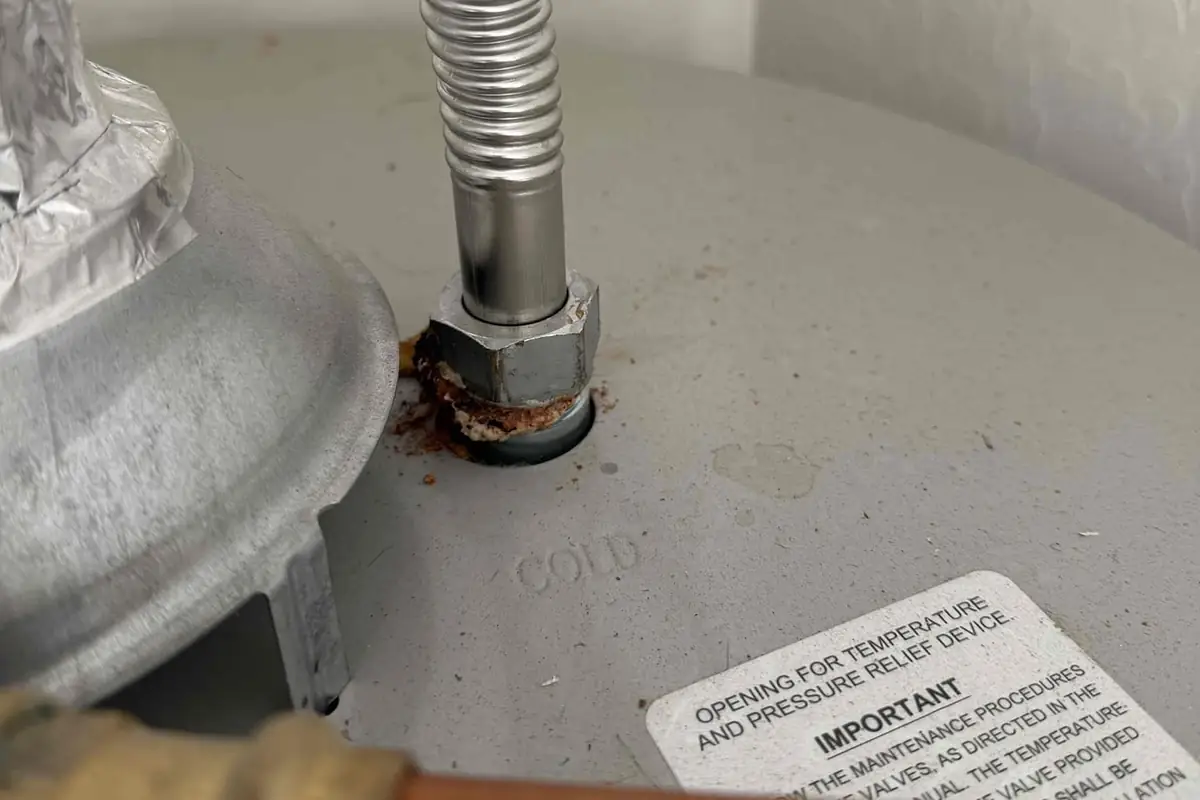
Water from the connections above the tank can run down the jacket, the painted metal shell around the tank, and pool at the base. The usual suspects are the unions (fittings that let the heater be disconnected without cutting pipe), the flex connectors and the threaded nipples in the tank. Heating cycles expand and contract these joints, and where dissimilar metals meet, corrosion and hard-water crust can open a slow seep.
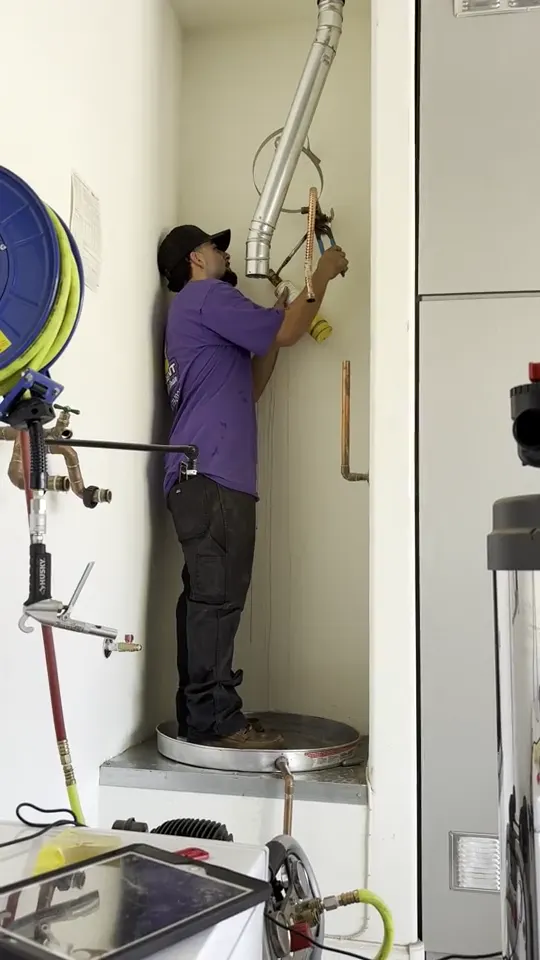
A water heater leaking at a fitting needs a repair, not a new tank. The Scottsdale guide lists unions within 12 inches of the heater as part of a correct installation. That lets a connector or nipple be swapped without disturbing the other piping.
When the tank itself has rusted through
Inside the steel tank is a sacrificial anode rod, a metal rod that corrodes so the tank does not. The Scottsdale guide says the rod is usually magnesium or aluminum, and once it is used up, the tank begins to corrode. Water softeners can wear the anode out faster, and the guide names sediment that overheats the tank bottom as the other main cause of failure.
A water heater leaking from the tank seeps at the base of the jacket or into the burner compartment while every fitting above stays dry. The guide is direct: almost every part of a water heater can be fixed or replaced except the tank, and a rusted-through tank means replacement.
Repair or replace: let the source decide
Once you know where the water starts, the choice is usually clear.
- T&P valve: a repair, once pressure and expansion control are checked.
- Drain valve: a repair, ideally with a brass ball valve.
- Union, flex connector or nipple: a repair to the seeping fitting.
- The tank: a replacement, because no sealant makes a rusted tank safe to keep.
For a valve or fitting, water heater repair puts the heater back in service and keeps the tank. When the tank has failed, water heater replacement is the path. It is also the time to add a missing cold-water shut-off or expansion tank. If you find more than one wet spot, call us before replacing parts, since a seeping tank makes valve work pointless.
How to shut the heater down safely
Water from the tank or the T&P discharge can be hot enough to scald, so keep your hands and face clear of both. Gas and electricity near standing water add their own hazards, so shut the heater down first.
- Gas heater: turn the gas control knob to off, and if you smell gas, leave the house and call your gas utility from outside.
- Electric heater: switch off its breaker, and do not touch the unit while standing in water.
- Cold-water inlet: close the shut-off valve on the cold line, which the Scottsdale guide lists as required.
- Main valve: if that valve will not close, use the house shut-off. City of Phoenix Water Services’ plumbing tips say it is usually near a hose bib at the front of the house, and warn against using the meter.
Drying the floor, tracing the drip and shutting the heater down are the homeowner’s part. Replacing a T&P valve, working on gas lines or venting, testing pressure and swapping a tank are jobs for a plumber, because each one involves the devices that keep a heater from overheating or leaking gas.
Frequently asked questions
Is a water heater leaking from the bottom an emergency?
It is when the tank is leaking, a fitting is spraying, or water is reaching gas controls or wiring, so shut the heater down right away. A slow drip from a drain valve can usually wait for a scheduled visit, but do not ignore it.
Can a leaking tank be repaired?
No. The Scottsdale guide says a tank that has rusted through cannot be repaired, although valves, connectors, anode rods and most other parts can be replaced.
Why is water dripping from the pipe on the side of my water heater?
That pipe is the T&P discharge line, so a drip means the relief valve is opening from wear, heat or pressure. On a closed system, thermal expansion is a common cause, and a pressure test at a hose bib shows which you have.
Should I turn off my water heater if it is leaking?
Yes, if the water is coming from the tank or you cannot find the source. A small valve drip that drains away from anything electrical can usually wait for a repair visit.
Get the leak traced in Peoria
Have a water heater leaking in your Peoria garage and no clear source? Trident Plumbing & Drain can trace the water and walk you through the repair or replacement options. Call our Peoria office at (623) 879-2020 or our North Phoenix office at (623) 257-3481. You can also schedule service online and tell us what your check turned up.