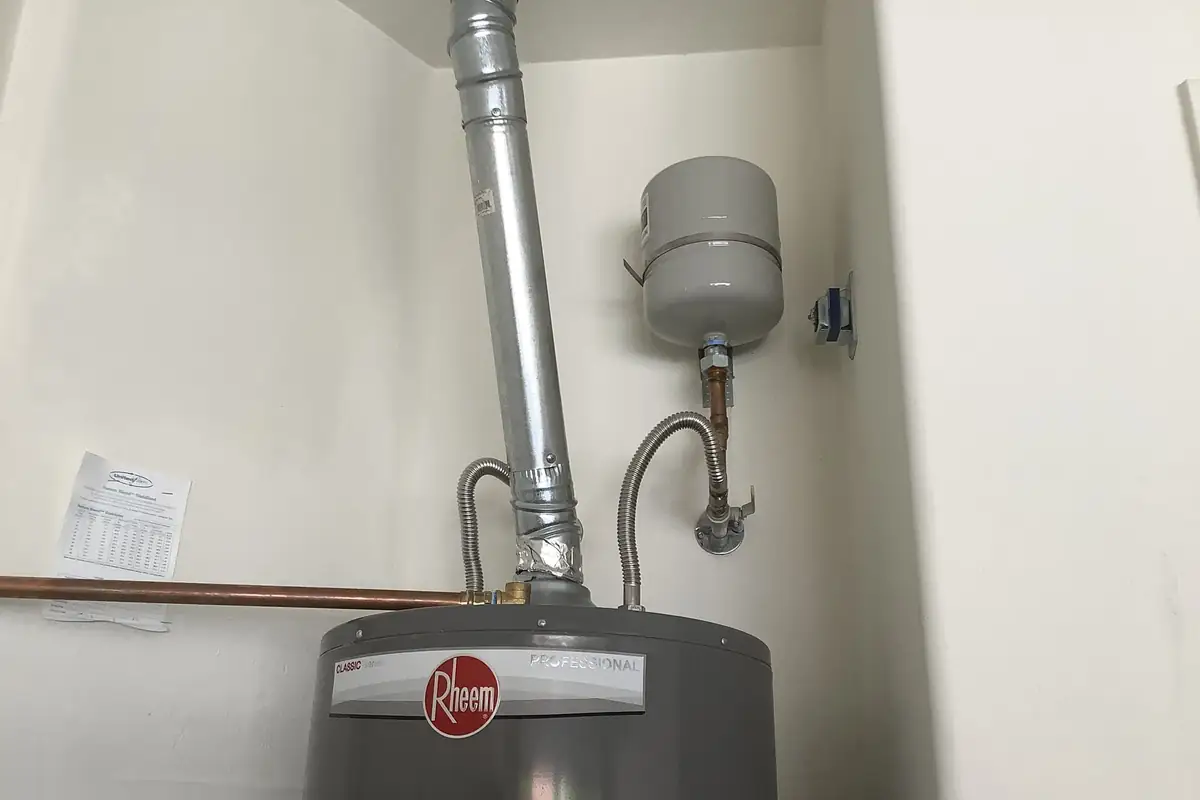
If the relief valve on your water heater drips after everyone showers, the missing piece may be a water heater expansion tank. This small steel tank sits on the cold-water line and gives heated water somewhere to go when it expands. In a closed plumbing system, it keeps the heater from straining against its own pressure. This guide explains the mechanism, the signs of a failed tank and how the common fixes compare.
Why heated water needs somewhere to go
Water expands when it is heated, and a tank-style heater warms a large volume of it several times a day. A technical bulletin from State Water Heaters, a water heater manufacturer, explains where that extra volume goes. In an open system, it backs out of the heater into the cold supply line, so pressure stays level.
In a closed system, something on the cold line blocks that path. The bulletin names a check valve (a one-way valve that only lets water flow toward the house), a water pressure reducing valve, or a closed shut-off valve. Because water barely compresses, the pressure climbs quickly.
The bulletin’s table shows pressure in a 30-gallon heater on a closed system rising from 80 psi to 145 psi as the water warms from 74°F to 80°F, and a normal heating cycle warms the water far more than that. The bulletin also warns that excess pressure can bulge the bottom head of the tank and distort its fittings.
It states plainly that “the temperature and pressure relief valve is not intended to protect against thermal expansion.” Giving that water a safe place to go is the job of a water heater expansion tank.
Why many homes in the area are closed systems
A pressure reducing valve, usually called a PRV, is a bell-shaped brass valve on the main water line that lowers street pressure for the house, and the bulletin lists it as a device that closes a system. In Phoenix, for example, Phoenix Water Services requires customers to install a pressure regulator on their side of the meter to keep pressure in the home from exceeding 80 psi.
Buckeye homes are served by their own water providers, so the Phoenix rule does not apply there directly. What matters is your own main line: if your Buckeye home has a PRV on it, treat the plumbing as a closed system. The bulletin adds two less obvious causes: a jammed water meter disc, and a water conditioning unit, such as a softener installed to deal with hard water.
How a water heater expansion tank works
A water heater expansion tank, often sold as a thermal expansion tank, is a small steel tank with two chambers. A flexible diaphragm or bladder separates the water side from a sealed cushion of air. When the heater warms a fresh batch of water, the extra volume pushes into the tank and squeezes the air, so household pressure rises only a little instead of spiking.
The air side is filled through a Schrader-style air valve, the same kind of valve found on a car tire. That pre-charge should match the home’s static water pressure (the pressure with no water running), following the tank maker’s instructions. We check it with a tire gauge while the tank is isolated from water pressure, because a reading taken with water pushing on the diaphragm is misleading.
The tank also has to be matched to the heater’s volume and the home’s pressure using the maker’s sizing chart, which is why the bulletin calls for a correctly sized tank.
Signs your expansion tank needs repair or replacement
A water heater expansion tank does not last forever, and a typical failure starts at the diaphragm. Once the rubber tears, water floods the air side, the cushion disappears and the tank becomes waterlogged. From then on, the system behaves as if there were no tank at all.
In Buckeye, it often looks like this. The T&P discharge pipe on the outside wall drips every evening after the family’s showers, then is dry by the next afternoon. If you don’t see a puddle, look for a white mineral stain under the pipe, because that stain is a sign the valve has been releasing water. The heater is refilling with cold water, heating it, and pushing the expanding water against the relief valve because the tank can no longer take it.
Other signs to watch for:
- Pressure climbs overnight, which a gauge with a telltale needle (a second pointer that holds the highest reading) can reveal when left on a hose bib.
- The tank feels heavy and sounds solid all the way up when you tap it, instead of hollow on the air side.
- Water, rather than air, spits out when the pin in the air valve is pressed briefly.
Expansion tank, T&P valve or PRV: comparing the options
When the problem is thermal expansion, homeowners usually hear about three fixes, and they do not do the same job.
- Relying on the T&P valve. Scottsdale’s building department’s water heater guide describes the temperature and pressure relief valve as one that releases pressure when pressure or temperature reach an unsafe level, and the State Water Heaters bulletin says it is not intended to protect against thermal expansion. Letting it open every evening wastes water, and hard-water minerals can collect on the valve seat until it weeps constantly.
- Turning down the PRV. A lower setting gives the system a lower starting point, but the expanding water still has nowhere to go, so pressure climbs from there each time the heater runs. A failing PRV can let street pressure creep up and deserves a pressure test, but adjusting it does not solve expansion.
- Adding or replacing the water heater expansion tank. This is the fix the manufacturer calls for, since the bulletin states that the installation instructions require a correctly sized thermal expansion tank on a closed system, or the warranty is void. A working tank addresses the cause and lets the relief valve go back to being a backup.
When the existing tank is waterlogged, expansion tank replacement is usually the whole repair. If the relief valve weeps on its own from mineral build-up, it may need its own water heater repair once the pressure is under control.
Safety warnings and when to call a pro
Thermal expansion problems combine two hazards: scalding water and stored pressure.
- Never cap, plug or valve off a T&P discharge pipe to stop a drip, because blocking it removes the heater’s final safety device.
- Stay clear of the discharge outlet. The Scottsdale guide notes that because of the scalding risk, the discharge is piped outside and pointed downward.
- Test the valve with care. The same guide says manufacturers recommend lifting the test lever periodically, but the water is scalding and an old valve may not reseal.
- Treat a bulging tank bottom or distorted fittings as urgent: turn off the heater, close its cold-water shut-off and call for help.
Call a professional when the relief valve keeps dripping, when a gauge reads above 80 psi (the level at which Phoenix Water Services says owners need to act), when the tank is waterlogged, or when you are not sure your home is a closed system. Adding a water heater expansion tank means relieving pressure, cutting into the cold line, sizing the tank and setting the pre-charge.
Frequently asked questions
How do I know if my expansion tank is bad?
Start with the tap test and the air-valve check described above. If both point to a waterlogged tank, or a T&P valve dripping after showers keeps coming back, the tank has stopped absorbing expansion and needs replacing.
Where does the water heater expansion tank go?
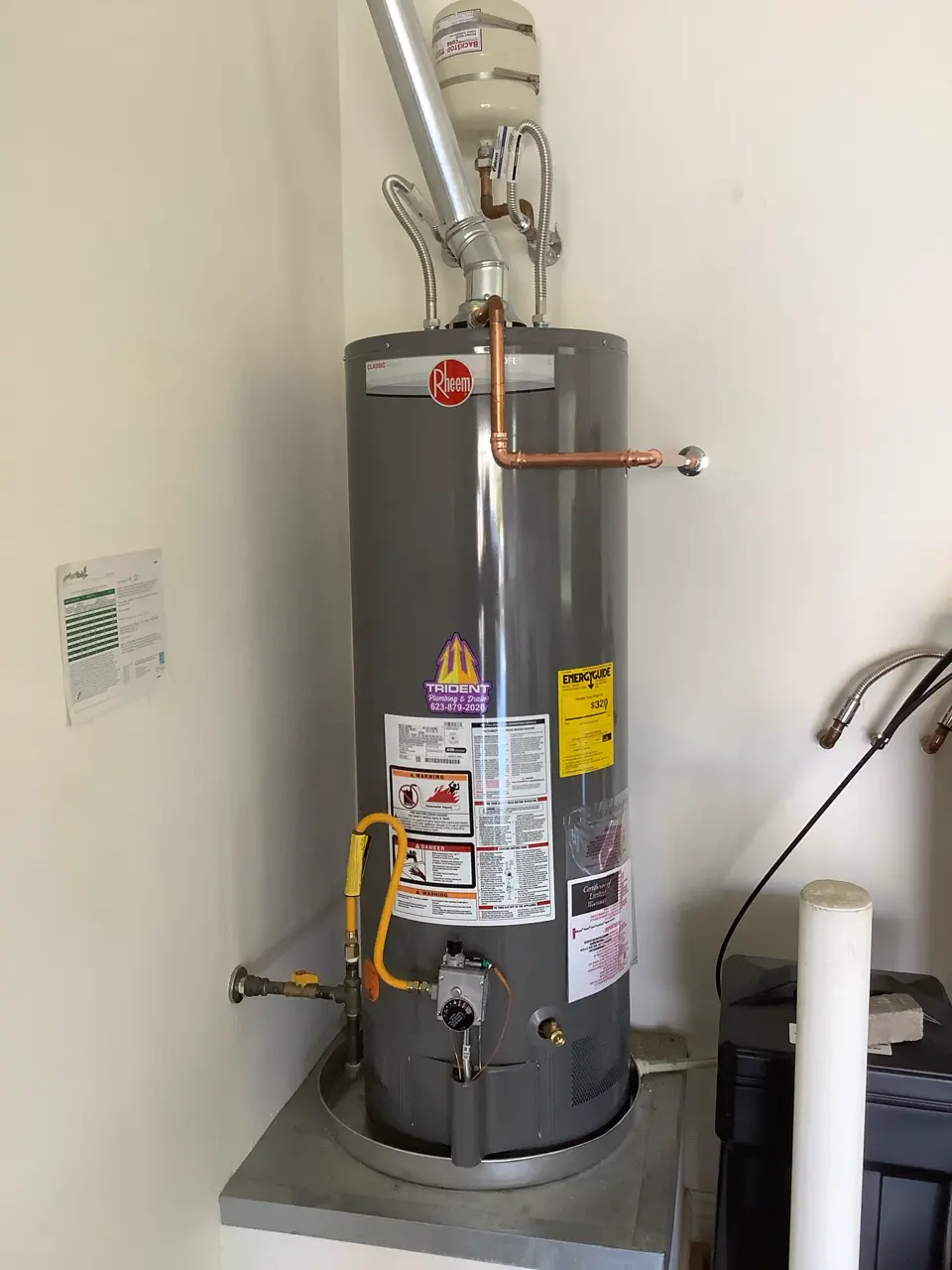
It connects to the cold-water line that feeds the heater, on the house side of the check valve or PRV that closes the system. Many are mounted above the heater, like the one in the photo above. The tank maker’s instructions cover the mounting position and whether a support strap is needed.
Does a new water heater need a new expansion tank?
The State Water Heaters bulletin says its installation instructions require a correctly sized thermal expansion tank on a closed system, so read the manual for whatever heater you choose. An existing tank can stay only if it suits the new heater, holds its pre-charge and is not waterlogged. During a water heater installation, we check the existing tank and set the pre-charge to the home’s static pressure.
Get your expansion tank checked in Buckeye
A dripping relief valve rarely fixes itself, and the pressure behind it keeps working on the tank and fittings every time the heater runs. If you see these signs in your Buckeye home, call Trident Plumbing & Drain at our Peoria office, (623) 879-2020, or schedule service online. We can test your water pressure, check the water heater expansion tank and its pre-charge, and explain whether the tank, the relief valve or the PRV needs attention.