
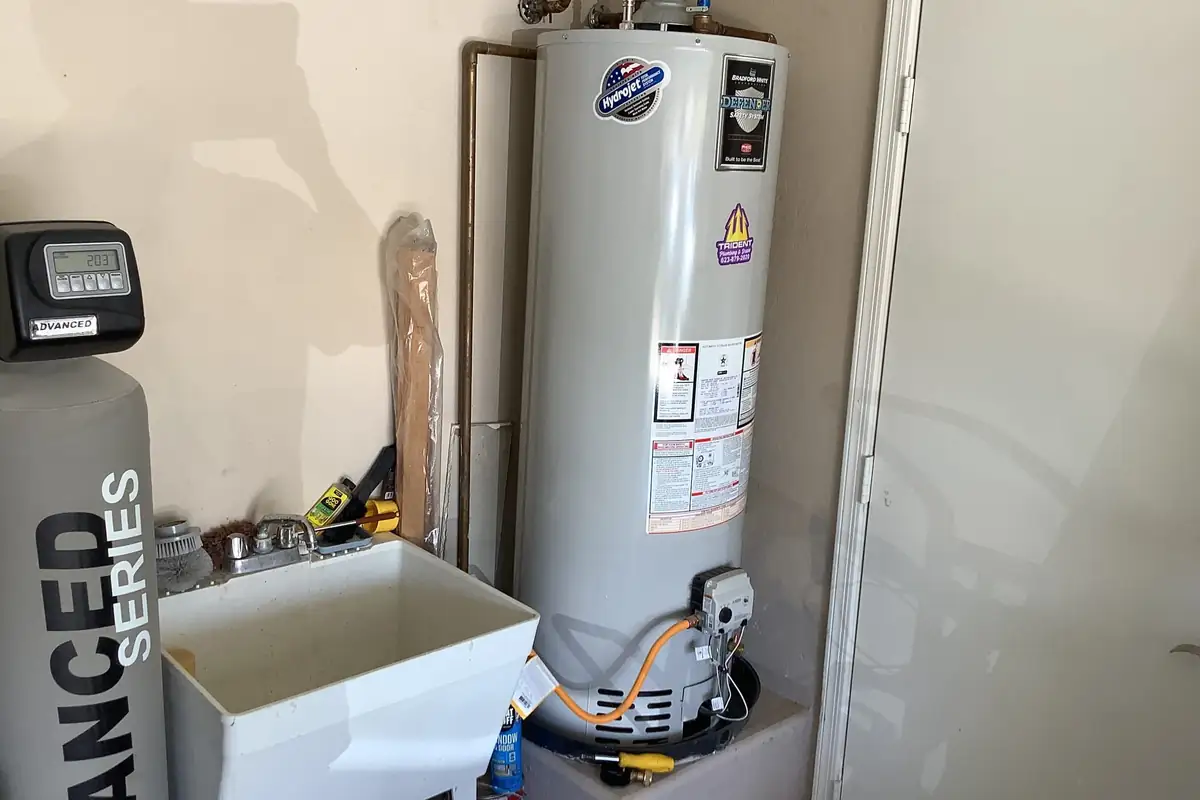
A tank water heater holds a large amount of very hot water under pressure, and a gas model burns fuel inside your home. Water heater installation requirements exist to keep those risks in check. This guide covers what a compliant tank install includes, why each rule is there, and what Peoria homeowners should check before a replacement.
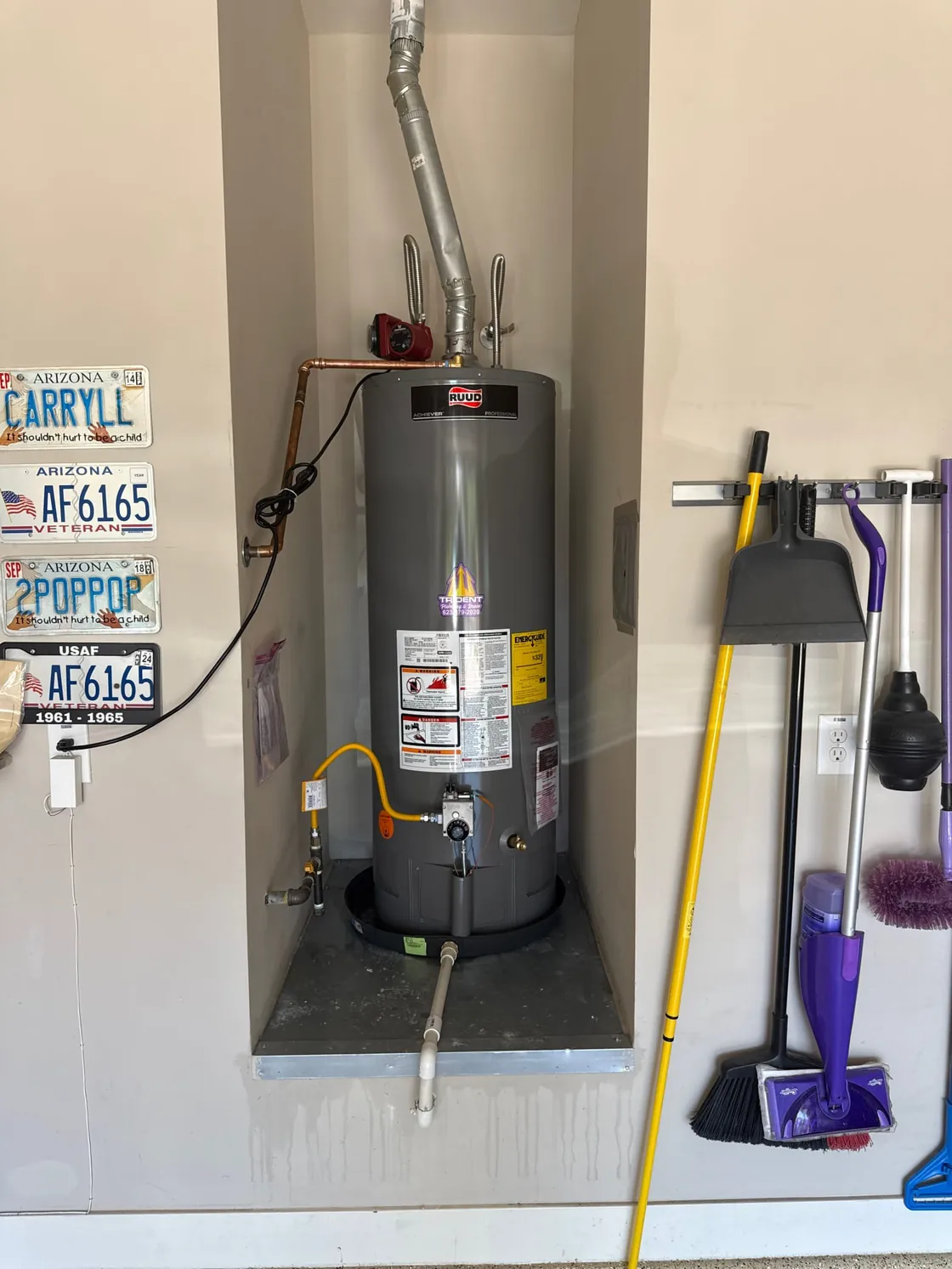
A Peoria garage replacement that needs a plumber
Picture a Saturday morning in a Peoria garage. The old tank has rusted through at the bottom, so it is time for a replacement. The homeowner shuts the heater off, measures the space and compares it with the replacement models that fit the household.
The likely replacement is several inches taller, so nothing would line up. The T&P drain pipe would end below the new valve, and the vent connector would no longer meet the draft hood (the metal collar that guides exhaust into the vent pipe). That is the moment to call a plumber, because each mismatch ties back to the water heater installation requirements in the code, and each rule exists because of something physical.
Permits, inspections and your city's rules
The City of Scottsdale’s Citizen’s Guide to Water Heaters makes a useful worked example. The guide cites Chapter 28 of the International Residential Code as the basis for its water heater installation requirements. It says a permit is required for water heater replacement in Scottsdale, and that the homeowner may obtain it. The owner is ultimately responsible for making sure a permit is obtained.
The inspection checks a new T&P valve and its drain, the gas valve, flexible connector and vent on gas units, grounding and bonding on electric units, and clearances. Those are the spots where a mistake shows up as scalding water, fire or exhaust in the house.
Peoria runs its own permit process, and its details can differ from Scottsdale’s. Before a water heater replacement in Peoria, ask the City of Peoria’s building department whether a permit is needed and how inspections work.
The T&P drain line: a safe exit for scalding water
The T&P valve (temperature and pressure relief valve, the valve with a lever near the upper part of the tank) opens when pressure or temperature in the tank gets unsafe. It can release a burst of scalding water or steam, so its drain line has one job: carry that discharge where it cannot hurt anyone. Scottsdale’s guide sets out these water heater installation requirements for the line:
- The guide calls for a minimum 3/4-inch drain line, so it can carry the valve’s full flow.
- The guide says the line must end outside, 6 to 24 inches above grade, pointing down.
- It must slope to drain with no trap, so water cannot sit in a low spot.
Pointing the outlet down sends hot water at the ground instead of at a person. Ending above grade keeps soil or gravel from burying the opening. A trap would hold standing water that can collect debris or freeze on a rare cold night, and a blocked line means the valve cannot relieve pressure.
In the Peoria example, the old pipe ends below the new valve. Splicing in a piece that climbs before it falls would create the very trap the guide prohibits, so the line usually gets rebuilt from the new valve outward. When we lift the test lever on a valve piped this way, the discharge should run straight out of the outside outlet.
Why a garage water heater sits on a stand
Garage elevation is one of the water heater installation requirements for gas and electric units alike. Scottsdale’s guide says a garage heater must be raised so pilots, burners, heating elements and switches are at least 18 inches above the floor. The reason is vapor. The U.S. Consumer Product Safety Commission explains that when vapors from gasoline or another flammable liquid reach a water heater’s burner or pilot light, they ignite and can cause a flashback fire. Those vapors collect low in a garage, so raising the pilot, burner and switches keeps them out of that layer.
The stand lifts those ignition sources above that layer, but it does not make fuel storage safe. The guide warns never to store gasoline or flammables near the heater, and the CPSC says gasoline should never be stored or used indoors, including in a garage, where its vapors can ignite. That matters in an Arizona garage that bakes all summer, because heat speeds evaporation. In the Peoria example, the fix is to rework the piping around the taller tank, not to set the heater on the floor.
Gas water heaters: combustion air, venting and room limits
A gas burner needs oxygen, and its exhaust has to leave the house. Scottsdale’s guide says gas heaters need combustion air under IRC section G2407 and proper venting under sections G2426 and G2427. A burner starved of air burns incompletely and can make more carbon monoxide. A loose, blocked or undersized vent can let those combustion gases, including carbon monoxide, spill back into the home.
The guide also bars gas water heaters from bedrooms, bathrooms and spaces reached only through them, unless the unit is direct-vent. A standard unit pulls combustion air from the room, so a venting fault in a bedroom could reach people while they sleep. A direct-vent unit (a sealed design that takes air from outdoors and vents straight outside) does not rely on room air.
Safety warning: if a carbon monoxide alarm sounds or you smell gas, get everyone outside without flipping switches or lighting anything, then call your gas utility or 911 from outside. The CDC’s carbon monoxide prevention guidelines also advise a battery-operated CO detector in the home and a yearly check of water heaters and other fuel-burning appliances by a qualified technician.
Valves, unions, clearances and electric units
The rest of the Scottsdale checklist keeps the heater safe and easy to service:
- Shut-off valve on the cold inlet. It stops water into the tank without shutting off the whole house.
- Unions near the heater. A union is a fitting that unscrews in the middle, and the guide wants them within 12 inches of the heater so it can come out without cutting pipe.
- Clearance from combustibles. Burners and flues give off heat, so the manufacturer sets how close stored items can be.
- Grounding and bonding on electric units. These give stray current a safe path, so metal parts do not become live if a fault develops.
- A brass drain valve. The guide notes plastic drain valves are common and can break, while a brass ball valve drains sediment more easily, which helps with hard water.
A manufacturer’s technical bulletin on bulging tanks explains that water expands when heated, and a check valve or pressure reducing valve (PRV) on the cold line traps that expansion in a closed system. The bulletin says the manufacturer’s instructions require a correctly sized thermal expansion tank on a closed system. The City of Phoenix, for example, requires customers to install a pressure regulator on their side of the meter. In Peoria, ask your water provider or a plumber what is on your own line.
Gas, electric and tankless compared
Most water heater installation requirements apply to every tank, but fuel type changes the focus:
- Gas tanks need combustion air, a sound vent, an inspected gas valve and connector, and a spot outside bedrooms and bathrooms unless direct-vent.
- Electric tanks skip combustion and venting, but still need the T&P line, garage elevation, valves, unions, clearances, grounding and bonding.
- Tankless units heat water as it flows, but gas models have their own venting and gas-supply requirements set by the manufacturer.
For a tank swap, see our water heater installation page. If you are weighing tankless water heaters instead, that page covers the equipment.
Frequently asked questions
Do I need a permit to replace a water heater?
In Scottsdale, yes: the city’s guide says a permit is required for replacement. Peoria sets its own rules, so ask your city’s building department before work begins.
Why does a water heater in a garage sit on a stand?
Flammable vapors from gasoline sink and collect near the floor. Scottsdale’s guide requires ignition sources in a garage to sit at least 18 inches above the floor, which keeps them clear of those vapors.
Where should the T&P drain line end?
Scottsdale’s guide says outside the building, 6 to 24 inches above grade, pointing down and sloped to drain with no trap.
Can a homeowner install their own water heater?
Scottsdale’s guide says a homeowner may obtain the permit, but the work must still meet the same water heater installation requirements and pass inspection. Gas, venting and bonding mistakes carry fire, scalding and carbon monoxide risks, so those parts are a job for a plumber, and your city’s building department can explain its own rules.
Getting a compliant replacement in Peoria
Each of these water heater installation requirements does a job: scalding water gets a safe exit, ignition sources stay above floor vapors, exhaust leaves the house, and the tank can come out when its time comes. If your swap looks like the Peoria garage example, have it checked before the new heater is fired up. Call Trident Plumbing & Drain at the Peoria office, (623) 879-2020, or the North Phoenix office, (623) 257-3481, or schedule service online.