
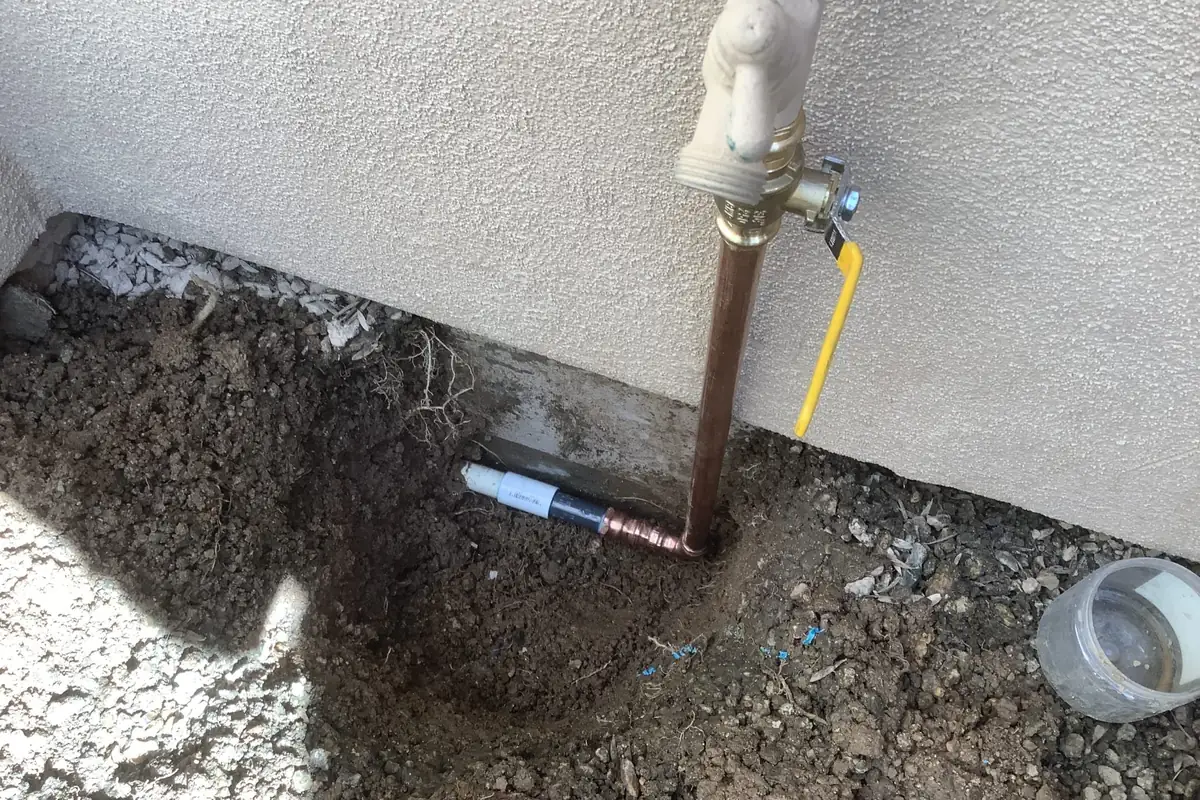
The braided supply line under a Peoria kitchen sink bursts on a weekday evening. Water sprays across the cabinet floor while the family searches the garage and then the backyard, all asking the same thing: where is the main water shut-off valve? Several minutes pass before someone finds it behind a shrub at the front corner of the house, right beside the hose bib (the outdoor faucet).
By then the cabinet base is soaked. This guide covers where the valve usually sits, which type you have, how to test it, and when it needs a professional.
Where does the main water shut-off valve usually sit?
City of Phoenix Water Services, in its household plumbing tips, says that for most houses the valve is at the front of the home near a hose bib. Look for a pipe that comes out of the ground and goes into the house with a valve, knob or lever on it, and check behind shrubs, rock and planters. The same guide notes that some older houses have the valve at the rear of the property.
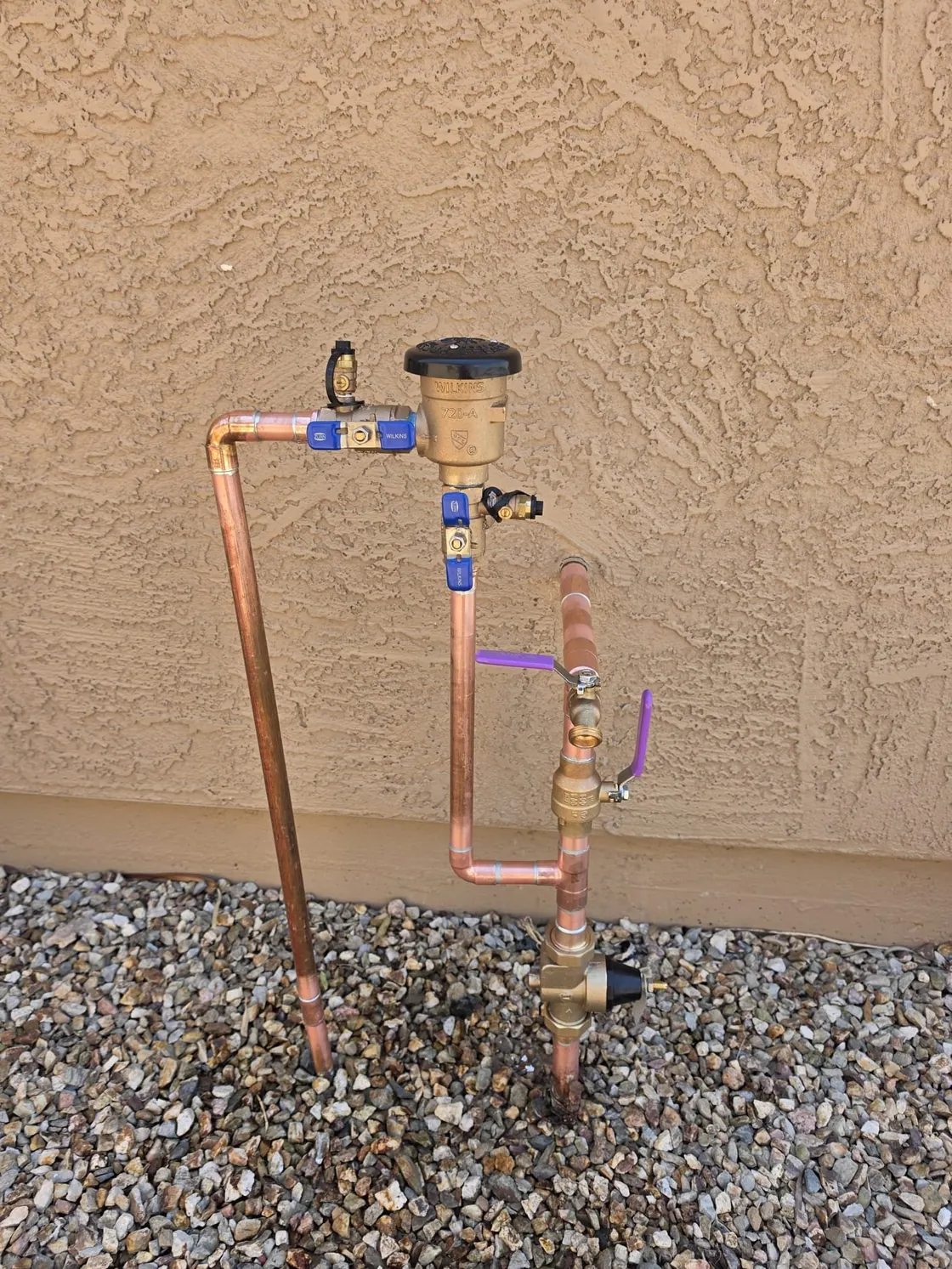
In this part of Arizona, the main water shut-off valve is often part of a copper assembly on the stucco wall. On an assembly like that, you will usually see three parts:
- Shut-off valve: a gate valve or ball valve on the pipe coming out of the ground.
- Pressure reducing valve (PRV): a bell-shaped brass regulator that lowers street pressure before it reaches your fixtures. City of Phoenix Water Services requires its customers to install one on the customer’s side of the meter to keep pressure in the home from exceeding 80 psi.
- Hose bib: the landmark the Phoenix guide tells you to look for, often fed from the same line.
Once you find it, clear away whatever hides it and show everyone in the house where it is.
Why not shut the water off at the meter?
The city’s tips sheet says not to use the meter box near the street, because the meter requires a special tool and you may be held responsible for repairs to a damaged meter. It also describes the meter as the dividing line between city and private responsibility for leaks, which makes the house shut-off valve yours to maintain.
If you cannot find or close your house valve, the same guide says Phoenix customers can call Customer Services at 602-262-6251 to have a technician shut it off at the meter. In Peoria, contact the City of Peoria’s water customer service for that help instead of trying the meter yourself.
Gate valve vs ball valve: which one do you have?
Most main water shut-off valves are one of two types, and each one fails in its own way.
- Gate valve: a round wheel handle that takes several turns. Each turn moves a threaded stem through the bonnet, the housing on the valve body, and drives a wedge called the gate down across the flow.
- Ball valve: a lever handle that needs only a quarter turn. Inside, a ball with a hole through it, called the bore, rotates to line up with the pipe or block it, sealing against two plastic rings called seats. A lever parallel to the pipe means open, and a lever crosswise to the pipe means closed.
Hard water is what ages these valves in Peoria and Phoenix homes. Dissolved minerals leave scale on a gate valve’s stem threads and in the groove where the wedge seats, and a valve left untouched for years can seize in place. When someone finally forces the wheel, the stem packing (the seal around the stem under the packing nut) often starts to drip.
The worst failure is a wedge that separates from the stem. The handle turns freely and feels like it is closing, but water keeps flowing because the gate never moved. Ball valves hold up better: scale and long idle periods can stiffen the lever, but a stiff ball valve usually still closes. A seized gate valve often will not seal at all, which is why it is normally replaced with a ball valve rather than repaired.
How do you test your main water shut-off valve?
Phoenix Water Services tells homeowners to know where the shut-off valve is and to test it regularly.
- Open a faucet inside the house, such as the kitchen sink, so you can watch the flow.
- Close the main valve slowly, turning the wheel clockwise or moving the lever crosswise to the pipe.
- Watch the faucet, which should slow and stop once the water left in the lines drains out.
- Reopen the valve fully and slowly, then check the stem for drips and run each faucet briefly to clear trapped air.
Go slowly because a sudden stop sends a pressure surge, known as water hammer, back through the pipes. If the valve will not move with firm hand pressure, stop there. A pipe wrench or cheater bar on a stuck gate valve can snap the stem or crack an old fitting, leaving water flowing with no way to stop it.
If you just bought a home in Peoria, put this test on your move-in list. The InterNACHI home inspection standards state that an inspector is not required to operate any valve or to inspect shut-off valves. A clean inspection report does not tell you whether the main valve works.
What about the other shut-offs in the house?
Smaller valves isolate one fixture while the rest of the house keeps running.
- Fixture stops: small valves where each supply line leaves the wall under sinks and behind toilets. Most are compression angle stops, named for the right angle between the wall pipe and the supply line. In the kitchen story, closing the angle stop would have stopped the leak, because the burst line ran downstream of it.
- Water heater cold-water inlet valve: Scottsdale’s building department water heater guide lists a shut-off valve on the cold-water inlet in its replacement checklist. It isolates the heater without shutting off the house. Do not confuse it with the temperature and pressure relief (T&P) valve on the tank, which the same guide describes as a safety release for unsafe pressure or temperature, not a shut-off.
- Water softener bypass valve: if your home has a softener, its bypass valve routes water around the unit so the softener can be serviced without a full shutdown.
When a pipe breaks somewhere you cannot isolate, the Phoenix tips sheet gives a clear order. Turn off the water at the main water shut-off valve, call a plumber, and leave the faucets open until repairs are complete.
If the system will drain, turn the water heater’s gas control to off or switch off its breaker, since a heater that keeps heating as the tank empties can damage its burner or elements. Stay out of standing water near outlets and cords until the power to that area is off. If water keeps coming after the main is closed, call us about emergency plumbing.
Frequently asked questions
Can I turn off my water at the meter?
No. Phoenix Water Services warns that the meter needs a special tool and that you may be held responsible for damaging it, so use your house valve or ask your water provider for help.
How often should I test my main water shut-off valve?
The city’s guide says to test it regularly without naming a schedule. Pairing the test with a seasonal home check keeps scale from having years to lock the valve in place.
What if the valve won’t turn?
Stop rather than forcing it. A seized gate valve can snap at the stem under a wrench, so have a plumber look at it instead.
Should I shut off the water before a long trip?
Yes. The Phoenix guide recommends shutting off the water to the house, and to the water heater where water enters it, before a long trip.
When should you call a professional about the valve?
Some valve problems are beyond a homeowner fix. Bring in a plumber when you see any of these signs:
- The valve will not close fully, and water keeps trickling during a test.
- The stem keeps leaking after a gentle snug of the packing nut.
- The handle is broken, stripped or spins without resistance.
- You cannot find a house valve at all, and the only shut-off is the meter.
Replacing the main valve means cutting the copper line on the house side of the meter and soldering or press-fitting a new valve in place, so it falls under water main repair and water line repair work.
If your main water shut-off valve is buried, seized, dripping or missing, Trident Plumbing & Drain can look at it and recommend the right fix. Call our Peoria office at (623) 879-2020 or our North Phoenix office at (623) 257-3481, or schedule service online and tell us what you found during your test.