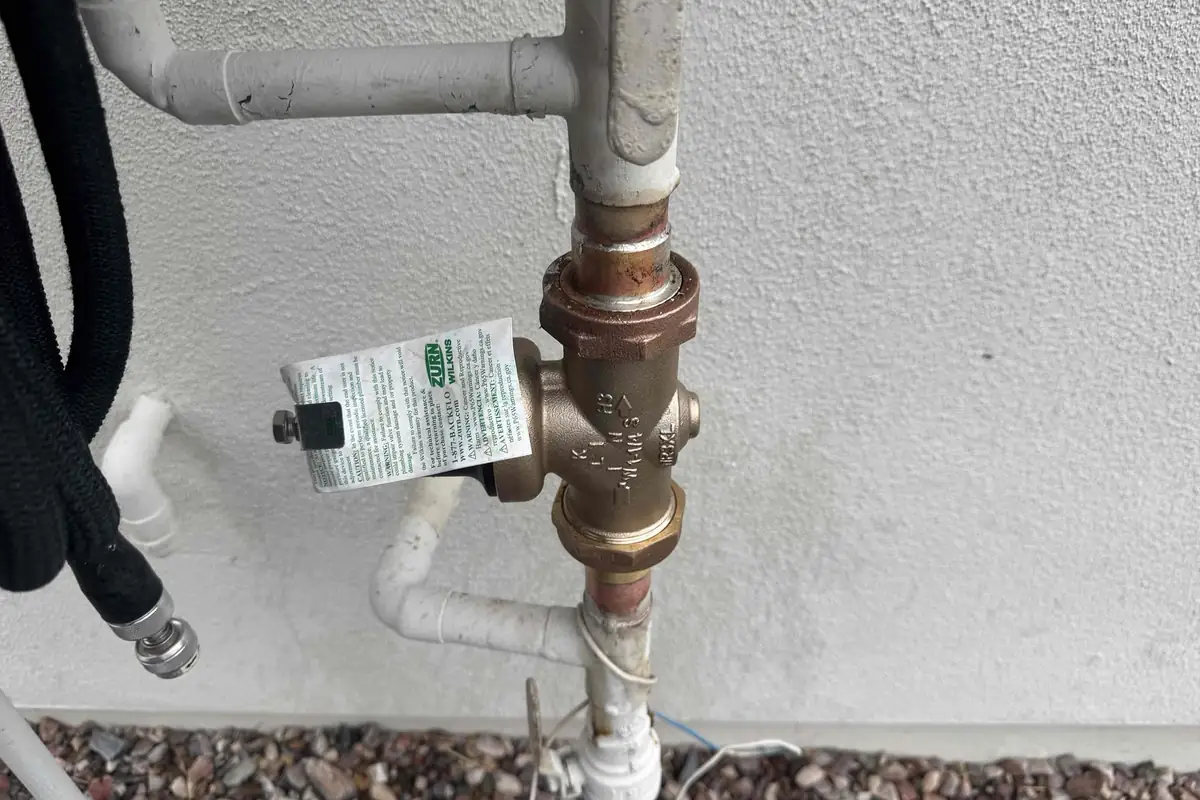
Picture a Peoria home where the pipes bang every time the washing machine fills. A toilet starts running on its own around midnight, and a gauge on the hose bib reads high before breakfast. Those symptoms usually trace back to one part, the pressure reducing valve on the main water line. Here is how that valve works, how it fails and how to test it.
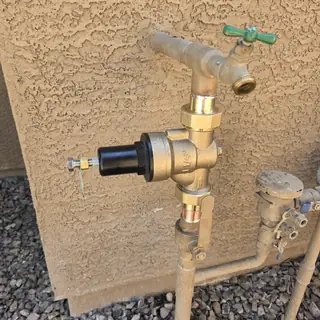
How a pressure reducing valve works
A pressure reducing valve, also called a PRV or water pressure regulator, lowers incoming street pressure to a level your fixtures can handle. Inside a bell-shaped housing called the bonnet, a spring pushes on a rubber diaphragm. The diaphragm moves a stem and a disc that closes against the seat, the opening all incoming water must pass through.
House-side pressure pushes back against the diaphragm. When a faucet opens, that pressure drops, the spring wins, and the disc lifts off the seat to let water through. When the faucet closes, pressure builds until it balances the spring and the disc settles back down. An adjusting screw on the bonnet sets spring tension: tightening it raises outlet pressure, and backing it out lowers it. Many models also have a strainer screen that catches sand and scale at the inlet.
How a pressure reducing valve fails
Each of those parts can wear out, and each failure shows up differently.
- Scale or debris on the seat: Hard water is common in Peoria, and minerals can build up until the disc no longer seals. Water then seeps past even when nothing is running, so house pressure creeps toward street pressure. With almost no water used overnight, the creep has hours to build, which is why readings often peak late at night and early in the morning.
- A fatigued spring or torn diaphragm: A tired spring lets the setting drift, and a torn diaphragm can no longer sense house pressure, so regulation turns erratic.
- A clogged strainer: A screen packed with sediment starves the house of flow, which causes weak pressure rather than high water pressure.
Why a failing valve causes banging pipes and running toilets
High water pressure shows up first in the fixtures that have to stop or hold back the flow. (For a broader look at what normal household pressure feels like, see our guide to understanding water pressure; this post stays on the valve itself.)
- Banging pipes: Washing machines and dishwashers fill through quick-closing solenoid valves. When one snaps shut, the moving water stops at once and a shock wave hits the pipes, which plumbers call water hammer. Higher pressure moves water faster, so the bang grows louder as the regulator loses control.
- Running toilets: The fill valve in the tank must shut off against whatever pressure the line delivers. When pressure creeps up overnight, water can force past its seal and spill into the overflow tube, so the toilet runs on its own.
- Spitting faucets: Faucets that blast or sputter when first opened are often releasing pressure built up overnight.
- A dripping relief valve: A pressure reducing valve makes your plumbing a closed system, as the water heater manufacturer State Water Heaters explains in its technical bulletin on bulging heaters. Heated water expands, and in a closed system that pressure has nowhere to go.
The bulletin shows pressure in a 30-gallon heater on a closed system rising from 80 psi to 145 psi as the water warms from 74°F to 80°F. It also states that the temperature and pressure relief valve (the T&P valve on the side of the tank) is not intended to protect against thermal expansion. That is why the manufacturer’s instructions call for a correctly sized thermal expansion tank on closed systems.
What Phoenix requires, and what to ask in Peoria
Phoenix Water Services says on its household water leaks page that customers must install a pressure regulator on their side of the meter to keep home pressure from exceeding 80 psi. The page adds that pressure above 80 psi requires action by the owner because it can damage pipes and appliances. It gives 40 to 100 psi as the acceptable range within the City of Phoenix.
The city is responsible from the street to the meter, and private pressure regulators are the homeowner’s responsibility. If your water comes from the City of Peoria, check with the City of Peoria for its own requirements rather than assuming the Phoenix rules apply.
How to test your pressure reducing valve with a hose-bib gauge
A pressure gauge that threads onto an outdoor faucet, or hose bib, shows what your regulator is doing. One with a maximum-reading needle, often called a lazy hand, also records the highest pressure reached while nobody is watching.
- Turn off every faucet, appliance and sprinkler zone so you read static pressure, with no water moving.
- Use a hose bib on the house side of the regulator, since some homes have one ahead of the valve that shows street pressure.
- Read the gauge first thing in the morning and again late at night.
- Open a faucet briefly, then close it and watch whether the needle settles or keeps climbing.
If the needle keeps climbing, the seat is probably leaking through. If it climbs mainly after the water heater runs, thermal expansion is likely part of the problem. A plumber testing a home like the one above takes both readings and checks the water heater before touching the valve. Trident Plumbing & Drain can also take these readings as part of its plumbing maintenance work.
Adjust, repair or replace: comparing your options
Once you know what the valve is doing, the choice comes down to three paths.
- Adjust: If pressure holds steady but is set too high, loosen the locknut, turn the adjusting screw a little at a time, and recheck the gauge after each change.
- Repair: If pressure creeps or flow is weak but the valve body is sound, a rebuild kit or cartridge can renew the seat, disc, diaphragm and strainer.
- Replace: If the body is corroded or leaking, the setting will not hold, or parts are unavailable, PRV replacement is the cleaner fix. Many new valves come with unions, threaded couplings that let the valve come out later without cutting pipe.
Before any repair, shut off the main house valve and open a faucet to relieve pressure. Phoenix Water Services warns homeowners not to shut water off at the meter, because it needs a special tool and you may be held responsible for a damaged meter. Never take a regulator apart under pressure, and remember that high water pressure strains supply lines, washer hoses and water heater connections until one bursts.
When to call a plumber
A small adjustment is reasonable homeowner work, but call a professional in these situations.
- The valve body or its fittings leak or show heavy corrosion.
- Pressure stays above the 80 psi limit Phoenix Water Services cites, even after adjustment.
- The T&P valve drips, or you have a regulator but no thermal expansion tank.
- The valve is buried or soldered in, so replacing it means cutting the main pipe.
Replacing a regulator means opening the main supply line, and Trident Plumbing & Drain handles that through its water line repair service.
Frequently asked questions
Where is the pressure reducing valve on my house?
It sits on the main water line on your side of the meter, usually near the house shut-off valve. Phoenix Water Services says most houses have that shut-off at the front of the home near a hose bib, where a pipe comes out of the ground and enters the house. Look for the bell-shaped fitting on that pipe.
Can I adjust my own pressure reducing valve?
Many homeowners can make a small adjustment with a wrench and a gauge, but go slowly. If turning the screw does not change the reading, or pressure drifts back up over the next few days, the valve needs repair instead. Never remove the bonnet while the line is pressurized.
Why does my water pressure change at night?
Phoenix Water Services says some pressure fluctuation is normal. When pressure climbs steadily overnight, though, the usual causes are a regulator seat leaking through while no water moves, or thermal expansion from the water heater in a closed system.
Do I need an expansion tank if I have a pressure reducing valve?
In most homes, yes. The State Water Heaters bulletin says a pressure reducing valve makes a system closed, and that the manufacturer’s instructions require a correctly sized expansion tank on closed systems or the warranty is void. If you are unsure about your own heater’s warranty, check its instructions or ask the manufacturer.
Get your pressure reducing valve checked in Peoria
If your pipes bang, a toilet runs at night, or your gauge reads above the Phoenix limit, the next step is a proper look at the valve and your water heater. Call Trident Plumbing & Drain at the Peoria office, (623) 879-2020, or the North Phoenix office, (623) 257-3481, or schedule service online. Trident Plumbing & Drain can test the pressure, check for an expansion tank, and repair or replace the regulator so your fixtures stop taking the strain.